Why Co-Applicant Journeys Are One of the Hardest Problems in Digital Lending Platforms ys
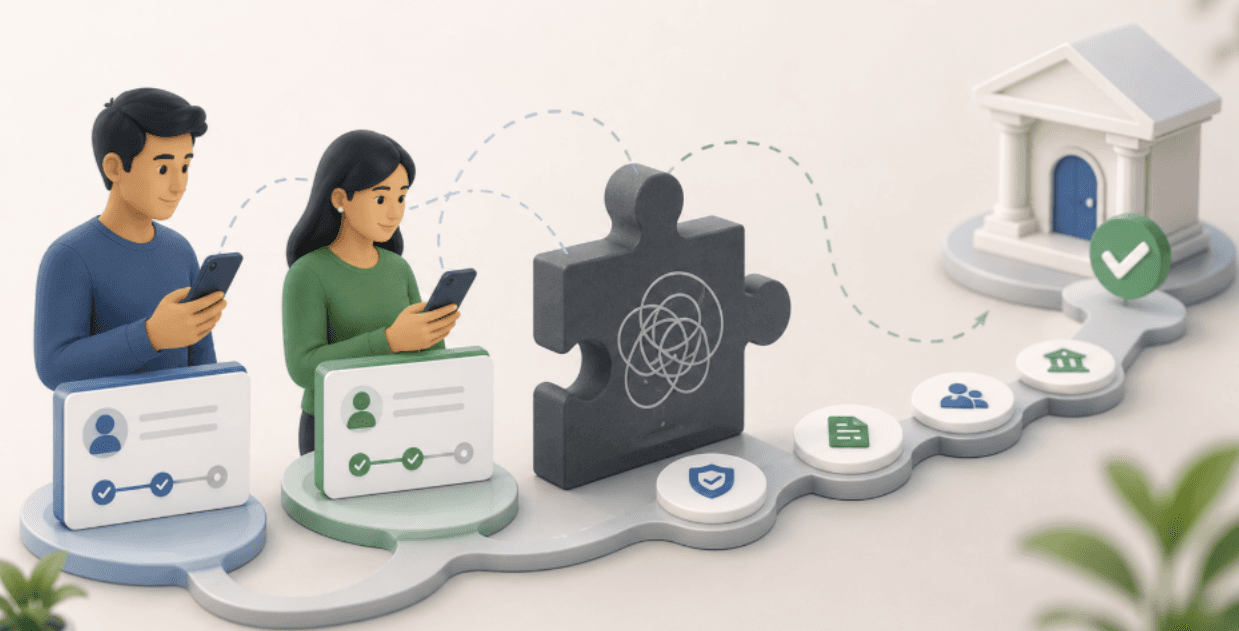
Education loan efficiency now depends on how intelligently lending platforms manage co-applicant verification workflows.
Most lending workflows are designed around a single financial identity.
Education loans break that assumption almost immediately.
In many education lending scenarios, the primary borrower is a student with limited or no income history. Repayment eligibility often depends on parents or guardians entering the process as co-applicants.
Now, a lending workflow must coordinate validations across multiple identities simultaneously:
PAN verification
Income assessment
Bank statement validation
Credit bureau checks
Video KYC
Address verification
Document reconciliation
What appears simple at the user level becomes extremely complex behind the system layer.
If co-applicant workflows are not designed properly, fragmentation begins quickly. Different identities move through separate validation cycles. Documents fail independently. Compliance checks lose sequencing consistency. Manual review queues increase.
This creates one of the biggest hidden inefficiencies inside education lending operations: workflow fragmentation caused by multi-party verification.
Many digital lending journeys unintentionally make this worse. They digitise onboarding screens while continuing to rely on disconnected backend processing for co-applicant coordination.
The result is operational inconsistency disguised as digital transformation.
This is why modern lending platforms are increasingly redesigning co-applicant orchestration as part of workflow architecture itself rather than treating it as an additional validation layer.
When handled properly, co-applicant coordination becomes significantly more predictable. Validation sequencing improves. Compliance workflows become cleaner. Approval consistency increases. Operational bottlenecks reduce.
Most importantly, applicants stop experiencing the process as repeated rounds of correction and re-submission.
The importance of this becomes even more visible in education lending because timelines are often fixed around admissions, fee schedules, and institutional deadlines. Delays caused by fragmented co-applicant workflows can directly affect a student’s ability to move forward with the academic process itself.
We helped a public sector banking implementation demonstrate how redesigning co-applicant orchestration within the lending workflow significantly improved consistency across approvals, validations, and disbursement readiness.
The larger industry shift is becoming increasingly visible: digital lending maturity is now increasingly defined by how intelligently platforms coordinate multiple participants within the same workflow.
Explore more